|
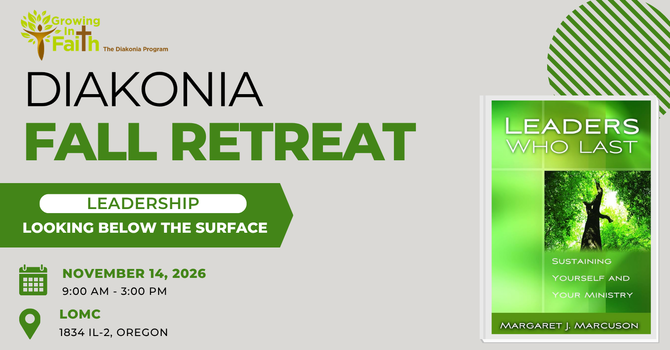
Diakonia
"The Teacher is here and is calling for
you"
John 11:28 says "The Teacher is here and is calling for you." This wonderful
quote of Martha's is just after she says to Jesus, "Yes, Lord, I believe that
you are the Messiah, the Son of God." She then goes to find her sister, Mary.
Is the Teacher calling you? Are you looking for a connection with God but
haven't found one? Perhaps the answer might be Diakonia. Diakonia gives you time
with God through a series of classes on the Bible, our church, possible ministry
gifts, and a variety of other courses. But it is more than just a class, it is a
chance to listen with your heart and soul too.
Diakonia is a two year program which meets once a week. Current classes are offered in
Cary, Rockford, Moline, and Peru in the Northern Illinois Synod as well as
Schaumburg and River Forest in the Metro Chicago Synod. All the classes are
taught by pastors and they will give you an opportunity to meet with brothers
and sisters in Christ to learn about the good news of Jesus Christ.
A full program description and course overview is found below.
If you are interested in Diakonia, please contact
Doug Liston at
815-331-3000
or dliston@premmag.com .
Program Overview and Course Descriptions
What is diakonia?
Diakonia is a two year process of spiritual formation and theological
education for baptized members of the Lutheran Church. This process occurs in
three basic ways:
—
By thorough grounding in the classic seminary disciplines of practical,
systematic, historical, and Biblical theology;
—
By identifying particular skills and aptitudes in ministry, and
encouraging their use in the local parish;
—
By providing spiritual growth through worship, retreats, and a supportive
community of fellow students, mentors, and instructors.
These are the tools diakonia uses to help equip
God’s people for service in parish and neighborhood ministries. The primary
theme and focus of the diakonia experience is the word of Jesus in scripture
(e.g. Mark 10:43): “Let the one who would be great among you be your servant
(Greek: Diakonos).”
What is the emphasis of diakonia?
Diakonia emphasizes the baptismal vocation of all Christians to serve as did
our Lord Jesus. Participants are usually already leaders in their parishes, and
have a high degree of commitment to the ministry of the Church. They want to
deepen their life of faith and ground their baptismal commitment to serve in the
scriptural, theological, liturgical, and historical traditions of the Church.
They are committed to serve through the Church in a variety of ways: teaching,
administration, liturgical leadership, action for social justice, evangelism,
visitation of the sick, community organization, youth work, ministry among the
elderly, and the like. In every way they seek, and are helped by diakonia, to
grow closer to the image and example of Christ the servant.
How is diakonia structured?
The diakonia curriculum consists of twelve courses, six per academic year.
Each course is 5 sessions in length, and meets weekly for 3 hour sessions.
Weekly assignments and reading reflect the twin purposes of relating subject
matter to the students' context of life and ministry (family, parish,
neighborhood area of ministry), and of giving a solid background to the topic.
Students work at their own level, and assignments reflect the understanding that
students are already busy in their families, jobs, and parish. Typically,
students average approximately two to five hours of studies per week in addition
to class time.
How much does diakonia cost?
1) Tuition: $300 per year (for the two year program). Pro rata refunds are
given for students who withdraw from the program.
2) Books: Actual costs vary from course to course, but instructors try to
provide materials for $25 or less per course.
3) Retreats: The number of retreats is determined by year, normally there is
one. Recent retreats have cost participants approximately $65 per weekend.
4) Fees: A nonrefundable registration fee of $25 is required at the time of
registration. An additional fee of $25 at the conclusion of the program covers
graduation expenses, including the presentation of a commemorative diakonia
cross.
Course Outline
Two years of formation
Twelve five-session courses
Series A
A1. Introduction to the New Testament The goals of this course
are twofold: the class together will seek to understand the content and
development of Christian faith and life in the first century Church as reflected
in the canonical books of the NT; students will also seek to understand and use
a variety of scholarly tools for biblical interpretation (including doing
exegesis on a NT pericope). Attention will also be given to acquire sufficient
background knowledge of NT themes and theology in order to evaluate contemporary
commentaries and gain confidence in preparing biblical devotions. Throughout the
course, students will reflect how the Gospel, as reflected in the NT, has shaped
our Christian lives. Sources have included: Reading the New Testament by Pheme
Perkins.
A2. Church History - The First 400 Years The purpose of this course is
to help students understand the doctrinal, liturgical, and organizational
development of the Christian tradition in its first four centuries. Attention is
given to the increasing role of theology and practice of this period in the
ecumenical, liturgical, and organizational conversations of today’s Church.
Included in this discussion is a study of Eucharistic Prayer, and how it
incorporates the theology of the first 400 years of Christian thought. Sources
have included: The Early Church by W.H.C. Frend. Assignments include
examinations of major figures and movements of this period.
A3. Practical Ministry I: Biblical Images of the Life of the Church
(diakonia, koinonia, leiturgia, kerygma) This course spends one class on each
image presented, considering its exegetical derivation and use in the New
Testament, as well as implications for the life of congregations and their
ministries. These concepts are related to the ongoing work of preaching,
teaching, counseling, worship, social ministry, and acts of mercy carried out
individually and corporately by the Church and her servants. They are studied in
their interrelatedness, all centered in the presence of Christ in our world and
our Church. going work of preaching, teaching, counseling, worship, social
ministry, and acts of mercy carried out individually and corporately by the
Church and her servants. They are studied in their interrelatedness, all
centered in the presence of Christ in our world and our Church. Assignments
include word students, using concordances as well as other Biblical study tools.
A4. Lutheran Creeds and Confessions The history and content of the
Book of Concord are at the heart of this course. Special emphasis is placed on
the Augsburg Confession and Apology, the Catechisms, and Smalcald Articles, as
well as the New Testament books of Romans, Ephesians, and Galatians. Topics
include: God and Sin, Justification by Grace Alone, Church and Ministry,
Sacraments, and others. Parish constitutions will be studied to show the
relation of confessional documents to modern Lutheranism. Sources have included:
Scripture, The Book of Concord, historical commentaries and Luther biographies.
Assignments include consideration of contemporary issues as influenced by these
16th century documents.
A5. Practical Ministry II: Visitation (the sick, the homebound, the
grieving) This course has two components: students will be provided the
opportunity to make several supervised visitations in institutions and/or the
homebound. Class sessions will deal with understanding the needs of patients and
loved ones, as well as issues such as grieving and patients’ rights. Besides a
sharing of practical issues relating to this ministry, this course will also
provide opportunities to relate visitation ministry to the theology and worship
life of the Church. The role of the Eucharistic Minister will also be explored.
Sources have included: Healing by Francis MacNutt, Good Grief by Grangier
Westburg, and Biblical passages from Psalms. Assignments may include conducting
and reporting on ministerial visits.
A6. The Daily Life of a Christian This practical theology course will
explore the meaning of Christian discipleship in daily life. The course will
help the student gain an understanding of the calling and vocation in the life
of the Christian in order to create a balance between ecclesiastical service,
family life, and secular work. Special attention will be given to the theology
of sanctification, the Reformation, understanding of vocation in work, and
family, the relation of the justified life to good works and the discipline of
the daily prayer offices. Sources have included: Scripture, The Book of Concord,
Luther’s The Freedom of the Christian, Bonhoeffer’s Life Together, portions of
Karl Barth’s Domatics Vol IV. Assignments may include keeping a daily journal to
record the student’s spiritual and emotional development.
Series B
B1. Introduction to the Old Testament The twin aims of this course
are: to give the students an overview of the Hebrew Scriptures, with special
attention to covenant theology; to relate Old Testament theology and history to
the present practical theology of the student by linking the five course units
to the five steps in the life of the local parish: beginning, growth and
expansion, success, decline, failure and renewal. Sources have included: Reading
the Old Testament by Lawrence Boadt, and Understanding the Old Testament by B.
Anderson.
B2. Christian Doctrine This course has several main objectives: to
introduce students to Systematic Theology, present a vision of the coherence of
the doctrines to each other, help identify foundational doctrines, give an
understanding of orthodoxy and heresy, give an understanding of communical and
historic nature of doctrines and their spiritual foundations, and to help
students understand and express why disciplined thought and faithful confession
is crucial for church leaders. The class will specifically focus on the biblical
writings of John and Paul. Sources have included: The Bible (particularly the
Gospel of John and the letters of Paul). Braaten and Jensen’s Christian
Dogmatics, various writings of classical and contemporary theologians.
B3. Lutheran Faith in the American Context The purpose of this course
is to place the Lutheran confessional movement in the context of other Christian
or non- Christian expressions in American history. Students will look at the
history of religion to understand the basic developments and schisms which have
occurred in various American Christian sects. History will also be reviewed to
understand its impact on today’s church and society (such as the current debate
regarding separation of church and state). This class is also intended to help
students witness and give a better and more informed account of the evangelical
faith, and to help address the issue of “why am I a member of a church of the
Augsburg Confession in this day and age?” Assignments may include a brief paper
on a review of a different faith or exploring the historical roots of a modern
issue or practice.
B4. Practical Ministry III: To Communicate the Gospel This series of
workshops will explore the role of the parish community or Word and Sacraments
as the context for ministry, the source from which the Christian witness flows.
Attention will also be paid to identifying 21st Century situation communication
of the Gospel as essential, and how this communication may occur. Underlying the
course is the perspective of each student in developing diaconal
self-understanding. We will explore together the particular gifts and strengths
each student possesses and the ways in which these gifts are communicated in
today’s world. Students will share personal ministry experiences, and reflect on
them both Biblically and theologically. In short, the course will help students
explore a Christian way of doing functional theology and ministry, “at that
exciting point where Word, world, and baptized servant converge.” Sources have
included: biblical passages on spiritual gifts. Assignments may include an
exegesis, developing a lesson plan for teaching and/or devotional use in youth
ministry, Sunday School, social ministry, leadership development, or adult Bible
study.
B5. Christian Worship This course surveys major aspects of liturgical
worship with special emphasis on the cultural settings in which worship occurs.
The course provides a practice understanding of the words, actions, and items
involved in the services by giving a close examination of what is in our service
books. It also ties the content of the services to their Biblical roots.
Sources have included: Lutheran Book of Worship, LBW Occasional Services, Manual
on the Liturgy by Pfatteicher and Messerli, and The Study of Liturgy, edited by
Jones, Wainright, and Yarnold, as well as devotional breviaries such as For All
the Saints by Frederick Schumacher. Assignments may include preparing public
prayer petitions, attending a liturgy of another faith tradition, writing an
overview of one of the Sacraments as publicly administered, or reflecting on the
rite of Baptism, Holy Eucharist, occasional services, or another part of the
regular service to its biblical and traditional roots.
B6. Themes and Issues in Christian Ethics Students will reflect on the
implications of the Ten Commandments for contemporary life. They will be
introduced to concepts and systems by which the Christian tradition has taught
personal and public morality, for example, the “Deadly Sins” and “Cardinal
Virtues”, the “Just War” theory vs. Christian Pacifism, human nature and human
sinfulness, and Luther’s “Two Kingdoms” theology. The course provides
opportunity for disciplined reflection on vexing ethical issues such as sexual
ethics, sanctity of life, political witness, and economic justice.
Sources have included: Basic Christian Ethics by Paul Ramsay, Faith and
Faithfulness by Gilbert Meilaender.
Diakonia Coordinator and Administrative Office
Doug Liston
5008 Hickory Lane
McHenry, IL 60050
815-331-3000
Locations in Illinois
St. Barnabas
Lutheran Church, 8901 S Cary-Algonquin Rd, Cary, IL (847) 639-3959 Saturday
mornings.
Grace Lutheran Church 7300 W. Division Street River Forest, IL 60305-1552
708-366-6900 Saturday mornings
Prince of Peace Lutheran Church 930 W. Higgins Road Schaumburg, IL 60195
847-885-7010 Thursday evenings
Salem Lutheran Church 1724 15th
Street Moline, IL 61265 309-764-5613 Tuesday evenings
St. Mark Lutheran Church 675 N. Mulford Rd. Rockford, IL 61107 815-398-3557
Thursday evenings
St. Mark Lutheran Church 27 S. Edgelawn Drive Aurora, IL 60506-4301
630-897-4842 Saturday mornings
St. John's Lutheran Church, Peru, IL - Tuesday
evenings
St John Lutheran Church, 2000 Luther Dr, Peru,
IL (815) 223-1144 Tuesday Evenings
|